

Employment Development Services - Plan (EDS-Plan)
The EDS-Plan Phase service’s goal is to help our participants hone their job goal and create a portfolio to help springboard their job search!
EDS-Plan Phase Services

EDS-Plan Phase Overview
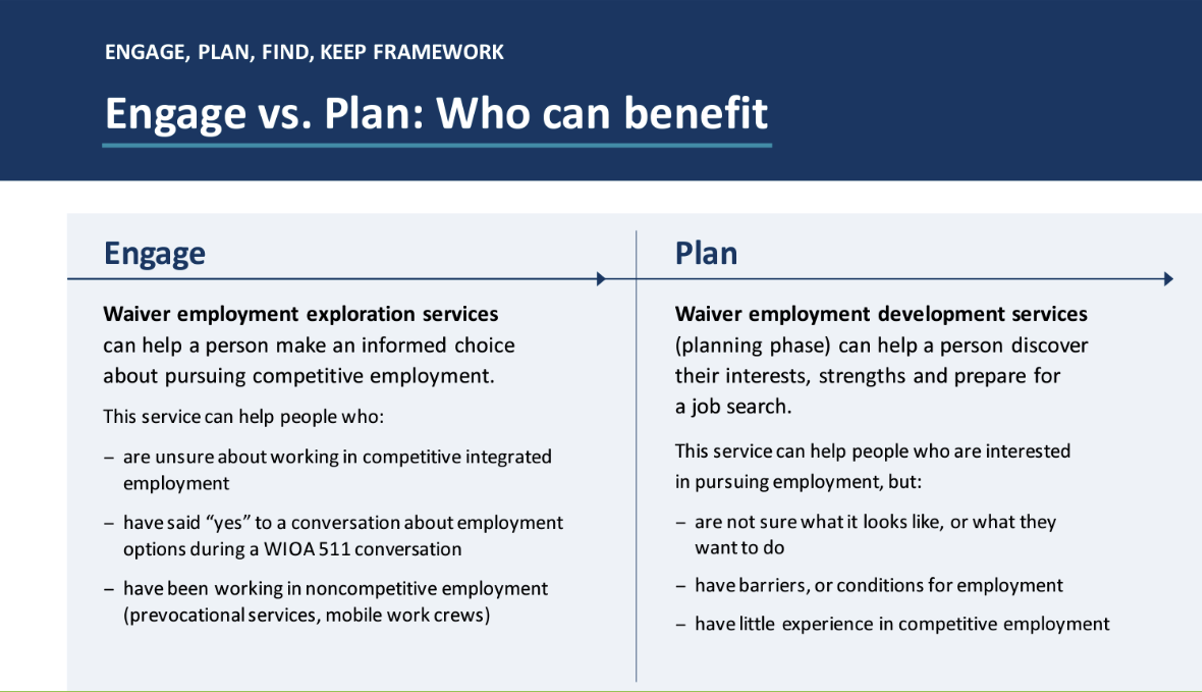
The Plan Phase is meant to springboard the job search and address experiences about the individuals we serve.
If an individual knows they want to find a job in the community and have an idea of what they want to do, then they’re probably past Engage Phase services. Plan Phase services may be a great fit! If all items on the Plan Phase checklist are completed and current, then they would move to the Find Phase.
There may or may not be an intake meeting for this phase. If your client is moving from another waiver service, you do not need an intake. If your client is new to Great Work, you would need an intake!
This phase is funded by Medicaid waivers (DHS)! The specific service funded in the EDS Plan Phase is Waiver Employment Development Services (EDS). You will see Waiver Employment Development Services (planning phase) on documentation like 6790s & referral forms.
“I'm really bored sitting at home! I want to work, but I don't know how to find a job or where to start.”
“I think it’s time for a new job. I haven’t job-searched in several years and don’t even have a resume.”
Important Deadline: EDS-Plan Phase participants can only in EDS-Plan for 120 calendar days.
EDS-Plan Phase Services:
-

Background Check
If you suspect or the client admits to not wanting to take the background check due to things that may pop up, this needs to be communicated to their case manager. Make sure to show understanding and compassion about this sensitive information and chat about how it's important to prepare for this if it comes up in an interview.
If someone does have a criminal history, it is recommended that you create a letter of explanation and roleplay giving the letter of explanation to the hiring manager.
-

Benefits Analysis
Completing a benefits analysis involves making a phone call with a client to find out what benefits they are receiving and then completing an estimate on DB101. This provides individuals with an estimate of how work might impact their benefits. You will complete a couple of scenarios based on their estimated wage to see how that will impact their medical or cash benefits. This is done in the Plan Phase.
Many of the individuals we support are receiving medical or cash benefits. Medical benefits help provide them with medical coverage, whereas cash benefits help them pay for their living expenses. These benefits are partially dependent on an individual's income that they are currently receiving. It is important that we help the individual understand how work will impact their benefits so they can make an informed choice about work.
It is important to remind them that they should talk with their benefits representatives for more information or questions.
Our role is to offer them information so they can make an informed choice. We should not be trying to convince them to work more or less hours based on their benefits analysis results.
-

Clear and Realistic Job Goal
Your client can request informational interviews, business tours, job shadows, and job try-outs to help develop a clear and realistic job goal and to gain insight into different opportunities.
Fill in what the person’s job goal is in the required section and record prior activities that help support them achieve it (even prior to Great Work)!
Example job goal: “[Client Name] would like to find a job doing [tasks, positions, etc.], working approximately [x] number of hours per week, earning at least [x]/hour. They are looking to travel approximately [x] miles or [x] minutes. They are available on the following days & times: [x]”
-

High Five
During the “High Five” section of the EDS-Plan, we are identifying five job openings in the area that match the individuals job goal, transportation plan, and scheduling requirements. The purpose of the high five is to verify that the job goal is clear and realistic before we move to the “Find” phase.
The High Five will also kickstart your job search process when you begin searching/applying for jobs!
The jobs found in the high five section must be concrete openings within the community, not theoretical positions. You must be able to cite specific job postings or have a connection with the employer to know that the job goal is realistic.
These job postings should also align with the clear and realistic job goal that you have created. If you are having a hard time identifying five concrete job openings that match the job goal, then they are not ready to move to the “find” phase. At this point, you should go back and make some adjustments/revisions to the job goal to make sure that you can easily find 5 or more openings that match the job goal!
-

Resume & Cover Letter Help
A great resume and cover letter should communicate your client’s skills and employment goals to the employer.
We offer traditional resumes, skills-based resumes, visual resumes, and video resumes. Keep all resumes in your client’s folder!
Meet with your client in order to fill out the resume and cover letter!
You can always reach out to the client’s team or family members to fill in gaps if the client doesn’t know or if they aren’t the best source of information for this step.
We must make sure that they have a resume + cover letter before we enroll them in VRS. Even if the team says they have it, double-check for proof!
-

Sample Application
Fill out this sample application with a client ensures that you have all the correct information to apply for jobs.
Meet with your client in order to fill out the resume and cover letter! You can always reach out to the client’s team or family members to fill in or if they aren’t the best source of information for this step.
This sample application is pivotal for a successful job search. If information is missing, it will waste time in the job search having to go back and fix it.
-

Transportation Plan
A transportation plan is a part of the EDS-Plan that goes over the primary form of transportation, its availability, area, costs, training needed, and backup transportation.
Important Note: We are ONLY able to assist with transportation if it is directly relevant to their employment goals!
We cannot assist with transportation for personal, medical or community access. If the individual needs help with that, then you can let the individual know that they should talk with their case manager. Hennepin County does not have a Lyft program.
-
Positive Support Summary
Description goes here -
Enrolling Participants in VR Services
Description goes here
EDS-Plan Phase Resources
Transportation Resources
Benefit Analysis Resources
Resume & Cover Letter Resources
Business Outreach Resources (Clear & Realistic Job Goal)
Enrolling clients in VR
EDS-Plan Phase Service Plan Timeline
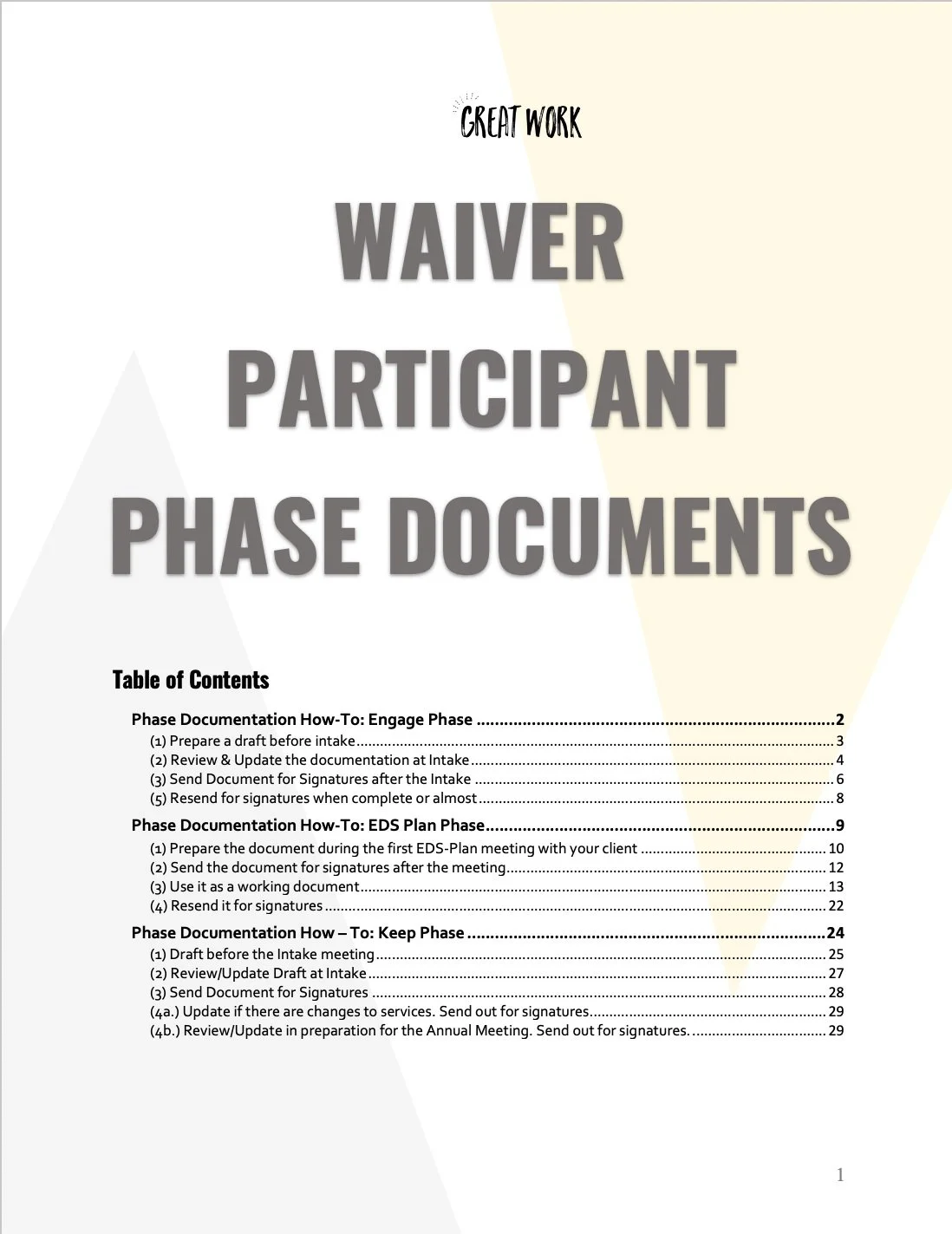
Prepare draft before intake
Review/update at intake
Send out to team following intake for signatures.
*This will be a “bare-bones” version.Use it as a working document and record information about completed activities.
Once activities are completed OR when the “Progress Review Date” is reached, send it to the team again for signatures.
*This will be a “complete” (or almost complete) version.
Engage Phase FAQs
-
We can get creative and customize services to our clients! Just make sure you loop in your supervisor to make sure your creative ideas align with services.
Some creative ideas are:
Roleplaying workplace scenarios with your clients
Taking your clients on self-guided tours of workplaces.
Building specific workplace skills or finding trainings on specific workplace skills for your clients to complete.
Finding day-in-the-life videos of careers
Finding career fairs to accompany your participant on.
Assisting with short-term volunteer experiences
We can’t provide communication with the employer. This just a learning opportunity!
Assisting with short-term internship experiences
We can’t provide communication with the employer. This just a learning opportunity!
-
In the Engage Phase, we are helping our clients explore and address barriers and concerns about integrated employment...
Check-in activities should mirror that! We can use check-ins to help address barriers, figure out career paths, and gain comfort in exploring the community for employment.
Engage Phase activities include:
Interest assessments
Career assessments
Skills assessments
Career information
Exploring different jobs
Be creative – Some clients may need more support gaining confidence or exploring and may need to take things slower or a new approach needs to be found.
-
Team members typically spend 3 - 4 hours a week meeting with and working on behalf of Engage Phase clients.
-
Engage Phase participants are typically met with weekly.
-
Some participants may need a little bit more time or a slower build up to partaking in business outreach opportunities.
You can take small steps towards them. For example, you could just stop by a business with a client to check it out and then leave. Then the next time, you can set a goal to ask a question to a worker… and so on and so forth until you build to an outreach oppurtunity!
-
One of the goals of Engage Phase services is to get our clients out into the community and explore employment through informational interviews, business tours, job tryouts, and job shadows.
These outreach opportunities can serve as valuable lessons in workplace and interview skills, etiquette, and hygiene.
Experiencing workplaces first hand can help your client achieve an educated choice and may illuminate areas that your client may like or want to stay away from.
-
An Engage Phase client moves on to the EDS Plan Phase when their concerns about working in the community and their potential barriers are addressed. They don’t need to have a specific job goal in mind, but should have a general idea.
Their Engage Phase Service Plan must be completed with the requested number of activities completed and documented on it. Send it out for signatures!
An Engage Phase client may decide that working in the community is not a great fit for them. That’s completely okay! Let your supervisor and their case manager know. May sure to ask respectful “Why?” questions to gather a full picture
-
We send an updated 6790 to the client’s case manager!
When an individual is changing services, we need to make sure that we include the previous authorization plus the new authorization. For example, if we currently have 200 units of Engage, but the participant wants to move on to EDS-Plan services. Then, we should send over a 6790 that includes:
The previous authorization of 200 units of Engage
Plus, the additional authorization of “X” units of EDS-Plan
Example Scenario
If EES is ending 10/28 and your participant wants to move on to EDS-Plan, the ECM would send a 6790 with EDS Plan starting the first business day after: Monday, 10/31 or you can use Saturday 10/29.
All logging ends in REV on the date the current unit ends on the 6790. If EES ends today on the new 6790, so does the service line in REV.
-
We send an updated 6790 to the client’s case manager!
When an individual is changing services, we need to make sure that we include the previous authorization plus the new authorization.
For example, if we currently have 543 units of Engage, but the client recently found a job and needs employment support instead. Then, we should send over a 6790 that includes:
The previous authorization of 543 units of EDS-Plan, ending on the day before they found a job
Plus, the additional authorization of “X” units of ESS beginning on the day they found the job.
Required 245D Meetings
Participants receiving Engage Phase services are funded by Waiver Services.
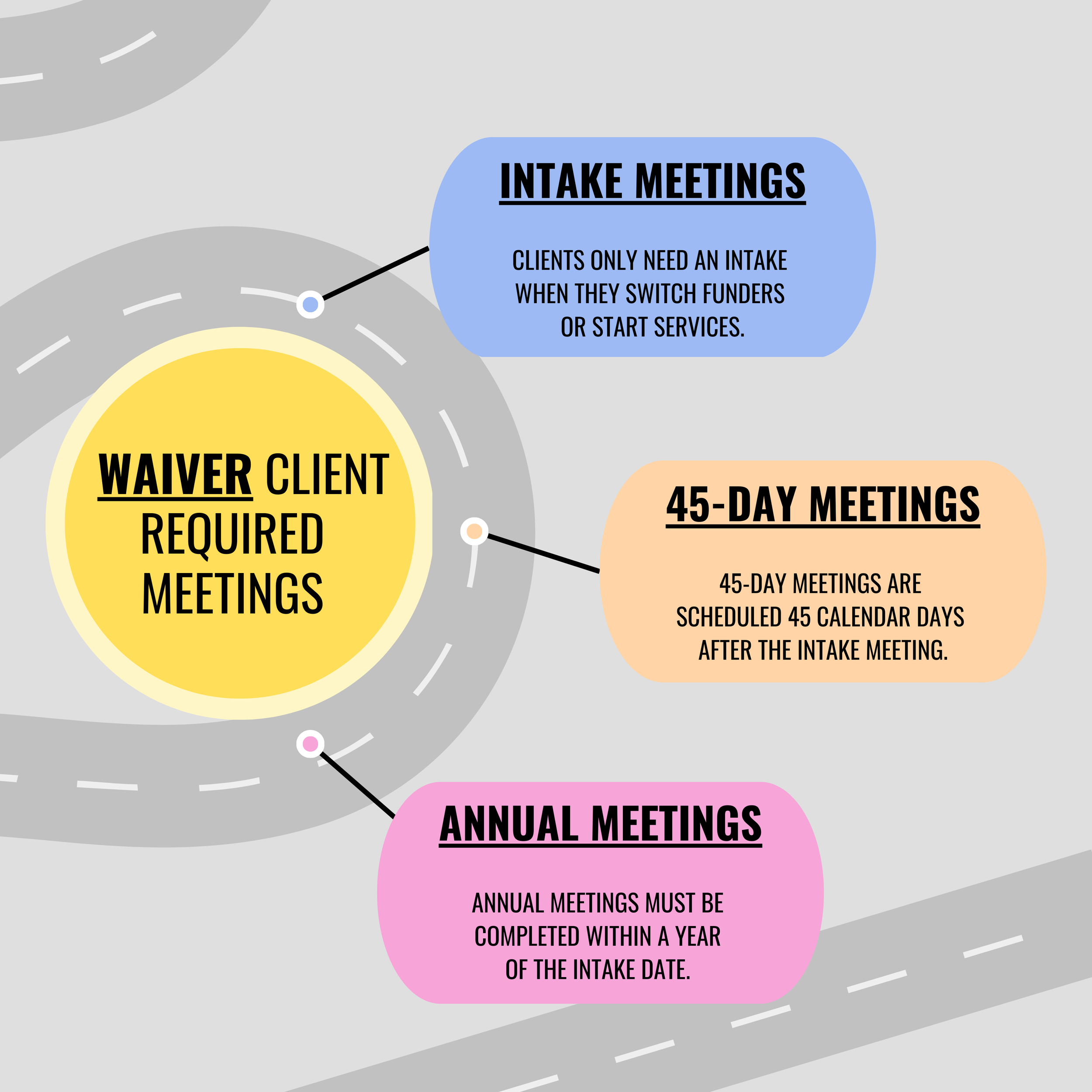
By 245D Statues, Great Work is required to lead Intake Meetings,45-Day Meetings, and Annual Meetings for all Waiver participants.
The purpose of an Intake Meeting is to go over Great Work’s Intake Paperwork as well as for the GW staff member to discuss how they can best support their client.
The purpose of a 45-Day Meeting is to check the progress made during the first 45 Days and make any adjustments needed.
The purpose of an Annual Meeting is to go over documentation and to ensure Great Work’s services best fit our client’s needs.
6790 Overview
The 6790 is the tool providers use to supply case managers with the information they need to complete authorizations for their clients to receive services from Great Work. The 6790 should reflect the current E1MN phase that the client is in and the number of units (or 15-minute increments) that we anticipate that we will use during a given time-frame.
6790s are only required for Waiver services. Employment Exploration Services (EES), which you provide in the Engage Phase, is a Waiver service. That means you need a 6790!

Weekly Email Updates
Every week by Friday, Great Work team members send a weekly email update to your client’s team giving them an update about how the week has been going, the progress that was made, and any concerns that you have. These should be informative, pertain to your client’s employment journey, and paint a picture of the progress for the week (even if there hasn’t been any). These should always be person-centered and maintain their dignity, even when sharing concerns.
A lot can happen in a week, but emails are more likely to be skipped over if they’re long. Try to fit it into two or three short paragraphs!
Your email updates should include any important people on that person’s team, including case manager, guardian, or any other service providers. Make sure you talk with the individual about whom they would like to be included in the email update!
We should be making meaningful progress each week. However, if you haven’t made any progress for the week, you should highlight why you weren’t able to make progress and what you plan to do next week to continue to make progress!
Engage Phase: Engage Phase activities you’ve arranged or completed, current progress towards completing the Engage Phase, and any barriers that you have encountered that have slowed the process down.
Plan Phase: Plan Phase activities you’ve arranged or completed, current progress towards completing EDS-Plan checklist, and any barriers that you have encountered that have slowed the process down
Find Phase: You will send a PDF report showcasing the placements for the week to the client’s team.
Keep Phase: Keep Phase email updates should include how is their job going and any concerns that came up. If there are areas of improvement needed, using the sandwich method (positive thing, one challenge, positive thing) can be a great way to introduce those concerns!